
The Lions Chose Listening: What the Venice 2025 Winners Said About Cinema Now
From Jim Jarmusch’s delicate family silences to Kaouther Ben Hania’s devastating act of witness, the 2025 awards celebrated filmmakers who made attention itself feel political.

Awards can make a festival look simpler than it was. Eleven days of argument, discovery, disappointment and surprise are reduced to a clean list of winners. Venice 2025 resisted that simplification. Its prizes formed not a league table but a set of ideas about what cinema can do: listen closely, preserve ambiguity, confront power, reveal labour and allow performers to carry contradictions that dialogue cannot resolve.
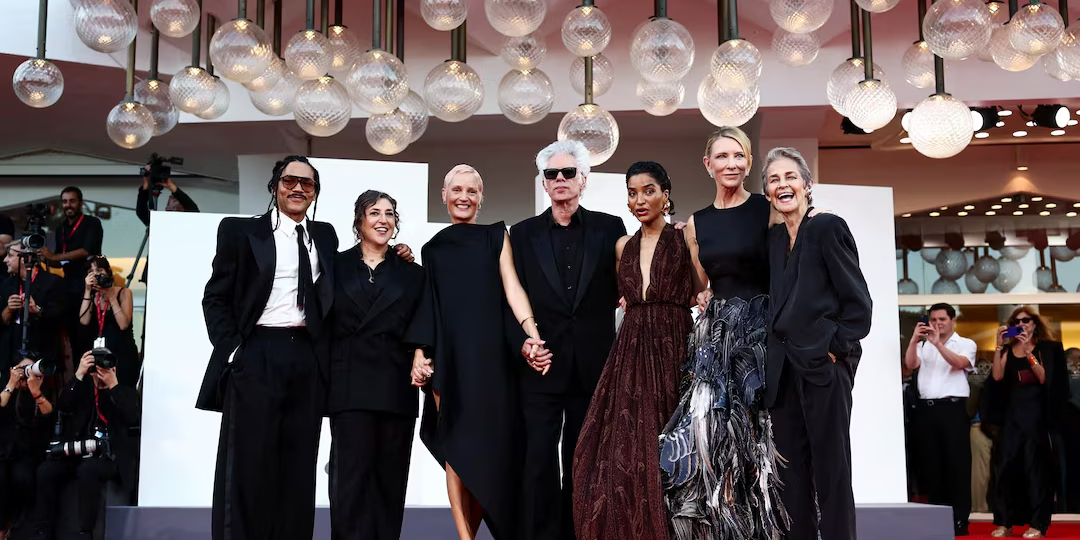
The Golden Lion for Jim Jarmusch’s Father Mother Sister Brother was the elegant centre of that philosophy. Structured as three stories about adult children and emotionally elusive parents, the film turns family life into a geography of awkward distances. Jarmusch’s cinema has always trusted rhythm over explanation. Here, the smallest exchanges become negotiations over memory, resentment and affection. His characters speak, but their real subject often remains just beyond language.
In another year, such quietness might have been mistaken for slightness. At Venice it became a statement. The jury led by Alexander Payne recognised a filmmaker using restraint with the precision of a composer. Jarmusch refuses the false climax in which a family finally explains itself. Instead, he watches the performance of normality: the cup placed on a table, the prepared anecdote, the pause before a question that will not be asked. The film’s humour does not neutralise pain; it makes the pain recognisable.
Its Golden Lion also affirmed the value of mature authorship without turning the festival into a museum. Jarmusch did not win for simply being Jarmusch. He won because his familiar minimalism met a contemporary loneliness. In an era of constant communication, his characters remain marooned in private versions of the same relationship. The film understands that families can share history while inhabiting different truths.
The triptych form is crucial to that understanding. Repetition creates comparison without forcing equivalence: different parents, different homes, different strategies for surviving proximity. The structure lets the spectator become alert to variations in temperature—a greeting that is slightly too formal, hospitality that conceals control, affection translated into objects because direct tenderness feels impossible. Jarmusch turns the family visit into a genre of its own, part comedy of manners and part ghost story.
If the Golden Lion honoured the ethics of quiet observation, the Silver Lion Grand Jury Prize confronted the ethics of hearing. Kaouther Ben Hania’s The Voice of Hind Rajab centres on the recorded voice of a six-year-old Palestinian girl trapped in a car under fire in Gaza, while emergency workers try to organise a rescue. The film’s form forces the audience to encounter the distance between a voice asking for help and the systems that cannot reach her in time.
The work generated one of the festival’s most emotionally charged responses because it made spectatorship uncomfortable in the necessary sense. Viewers were not offered the safety of abstraction. Ben Hania’s cinema asked what it means to listen when listening cannot undo what happened. It also asked how film can work with real testimony without turning suffering into spectacle. The Grand Jury Prize acknowledged not only the subject’s urgency but the formal responsibility required to carry it.
Placed beside one another, Jarmusch and Ben Hania may seem to represent opposite poles: fictional understatement and historical emergency. Yet both winning films depend on the moral weight of attention. Both treat a voice, a silence or a delay as consequential. Both reject the impatient habits encouraged by contemporary media. They ask the audience to remain present long enough for discomfort to acquire meaning.
This shared ethic helps explain why the jury’s decisions felt more substantial than a simple compromise between an auteur favourite and the festival’s most urgent political work. The prizes proposed two responsibilities for cinema at once. It must preserve the subtle, private textures that mass culture flattens, and it must face realities that power would prefer to keep distant. One responsibility does not cancel the other. Together they define the breadth of serious filmmaking.
Benny Safdie’s directing prize for The Smashing Machine added another kind of listening: attention to the body. Safdie’s film enters the punishing world of mixed martial arts through fighter Mark Kerr, exploring strength as performance and vulnerability as something the performance cannot permanently hide. The Silver Lion for Best Director recognised the control needed to hold physical spectacle and private collapse in the same frame. Violence is not only impact; it is aftermath, dependence, repetition and the strange loneliness of being watched for one’s ability to endure.
The acting prizes expanded the festival’s emotional range. Xin Zhilei won Best Actress for Cai Shangjun’s The Sun Rises on Us All, bringing a complex interior life to a story shaped by sacrifice, guilt and the consequences of past choices. Toni Servillo won Best Actor for La Grazia, Paolo Sorrentino’s opening film. Servillo’s great gift is to make thought visible without simplifying it. In a role bound to authority and moral decision, his stillness becomes dramatic action; the face registers the cost of judgement before the character speaks.
Venice’s screenplay award went to Valérie Donzelli and Gilles Marchand for At Work, a film concerned with creative labour and the price of choosing art over security. It was a fitting prize at a festival where glamour can obscure the practical reality of making anything. A screenplay is architecture built before the cameras arrive, and this award pulled attention back to the invisible work beneath the image. It also echoed the anxiety felt across the industry by artists trying to sustain a vocation within unforgiving economics.
Gianfranco Rosi’s Below the Clouds received the Special Jury Prize. Rosi’s cinema has long occupied the porous boundary between documentary observation and poetic construction. Turning his gaze toward Naples and the territory shadowed by Vesuvius, he finds history not as a chapter safely completed but as a layer beneath daily life. The prize recognised a film attentive to ruins, archives and the people who live among signs of previous worlds.
The Marcello Mastroianni Award for emerging talent went to Luna Wedler for Silent Friend, Ildikó Enyedi’s film linking human lives with the deep time of a tree. Wedler’s recognition was more than the customary gesture toward youth. It highlighted a performance capable of existing within an unusual scale, where botanical time and human emotion reflect one another. At a festival full of established masters, the award created space for discovery—the essential promise that cinema’s next language may arrive in a face audiences do not yet know.
Outside the main competition, the awards continued to widen the map. David Pablos’s On the Road won Best Film in Orizzonti, the section devoted to new aesthetic and expressive tendencies. Anuparna Roy won directing honours for Songs of Forgotten Trees. Nastia Korkia’s Short Summer received the Lion of the Future for debut film, while Maryam Touzani’s Calle Málaga won the Armani Beauty Audience Award in Venezia Spotlight. These prizes matter because the future of a festival cannot depend only on filmmakers who already command headlines.
Venice Classics offered another version of futurity by looking backward. The restored Iranian film Bashu, the Little Stranger, directed by Bahram Beyzaie, won Best Restored Film. Restoration is sometimes treated as heritage work separate from contemporary cinema, but Venice correctly places it inside the same ecosystem. A restored film does not merely preserve the past. It changes the present by allowing a new audience to see what history excluded, neglected or allowed to deteriorate.
The Immersive section pushed in the opposite temporal direction. Singing Chen’s The Clouds Are Two Thousand Meters Up won the Venice Immersive Grand Prize, while works by Négar Motevalymeidanshah and the team of Kate Voet and Victor Maes received further honours. Venice’s commitment to extended reality is not a prediction that headsets will replace cinemas. It is an acknowledgement that cinematic language has always evolved through experiments with space, presence and point of view.
Taken together, the 2025 winners offered a surprisingly coherent answer to the question of relevance. Cinema does not become relevant by chasing speed. It becomes relevant by creating conditions for deeper attention than everyday life usually permits. Jarmusch listens to what families cannot articulate. Ben Hania insists that the world hear a child. Safdie listens to the body; Rosi to landscape and buried history; Enyedi to time beyond the human.
The Lions, then, chose listening. That choice felt both aesthetic and political. In a culture where everyone is encouraged to react instantly, the awarded films demanded patience, proximity and doubt. They did not promise that attention could repair every loss. They argued that without attention, repair cannot even begin.
You may also like...
 Cardi B Performing in Nothing But a Bathrobe Is a Big Mood
 A Midnight Metallic Dress Code Created a Dazzling Scene at The Parrish Museum’s Midsummer Party
 Louis Vuitton Is Opening Its First-Ever Café and Restaurant
 Legendary Shoe Designer Sergio Rossi Dies From COVID-19 Complications
 Queen Elizabeth II Has Died at 96 Years Old
 A Fever Dream in the Desert: Ari Aster’s Eddington