
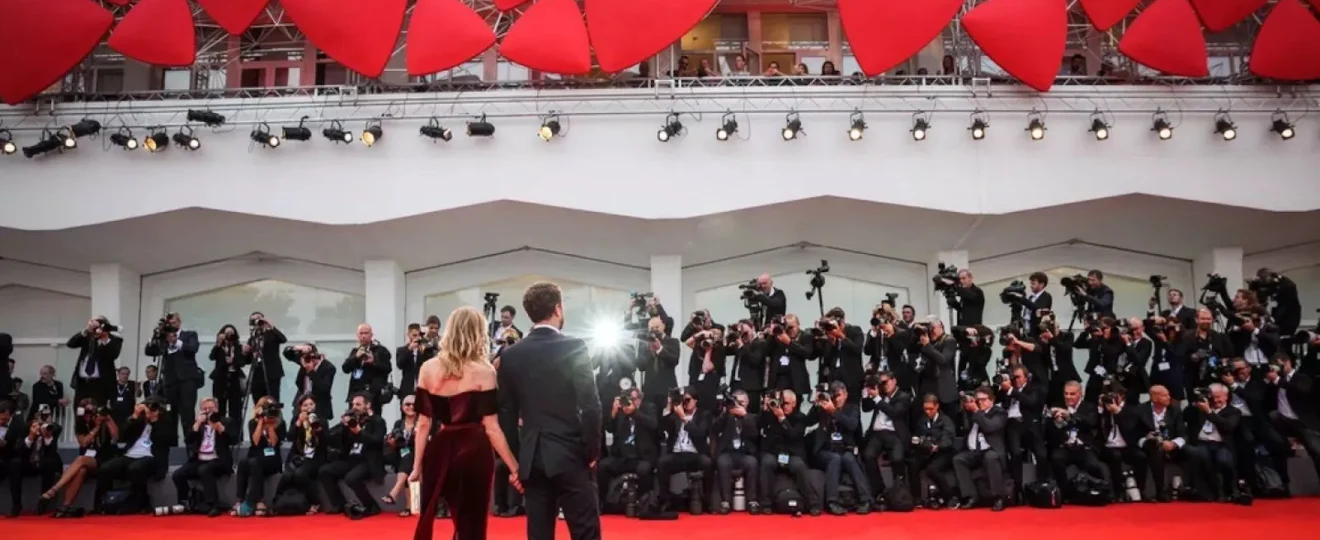
From Danny Boyle’s provocative opening film to a new generation of international auteurs, the 83rd Venice International Film Festival promises eleven days of glamour, artistic risk and serious industry business on the Lido.
Every September, Venice performs one of its most seductive illusions. A city that already appears to float between reality and imagination becomes the centre of the cinematic world. Water taxis replace limousines, hotel terraces become temporary boardrooms, and the pale modernist façade of the Palazzo del Cinema turns into a gateway through which the coming year’s most discussed films first enter public consciousness.
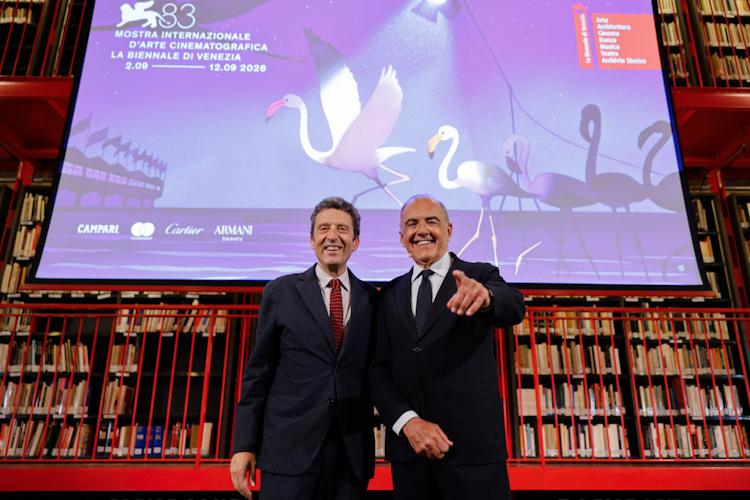
The 83rd Venice International Film Festival will take place on the Lido di Venezia from 2 to 12 September 2026. Directed once again by Alberto Barbera and organised by La Biennale di Venezia, the festival arrives at an uneasy but creatively fascinating moment for the global film business. Major studios are becoming more cautious, theatrical audiences remain unpredictable, and the boundaries between cinema, streaming, television, documentary and immersive storytelling continue to dissolve.
Venice, however, has never depended entirely on stability. Its power comes from anticipation: the possibility that a film shown at the Sala Grande tonight might become an Oscar contender, a cultural controversy or a modern classic by tomorrow morning.
An explosive opening: Danny Boyle’s Ink
The festival will begin with the world premiere of Danny Boyle’s Ink, screening in competition on 2 September. Adapted by James Graham from his acclaimed stage play, the film stars Jack O’Connell, Guy Pearce and Claire Foy.
Set in 1969, Ink revisits Rupert Murdoch’s acquisition of The Sun and his decision to place the newspaper in the hands of editor Larry Lamb. What follows is the creation of a more aggressive, populist and commercially irresistible kind of journalism—one that would transform the British press and anticipate many of the forces now shaping digital media.
It is an inspired choice for opening night. Boyle is a filmmaker of extraordinary velocity, capable of moving from the rebellious energy of Trainspotting to the emotional spectacle of Slumdog Millionaire. But the subject of Ink gives the film an additional relevance. This is not simply a period drama about Fleet Street. It is a story about power, attention and the moment when information became entertainment on an industrial scale.
At a festival surrounded by photographers, headlines, viral fashion moments and carefully constructed celebrity narratives, Ink may feel like both a historical drama and a mirror held up to Venice itself. The film will premiere in the Sala Grande before an audience that understands better than most how a single image—or a single headline—can travel around the world within minutes. La Biennale confirms that Ink is the opening competition film.
A competition shaped by auteurs, not algorithms
If recent festival seasons have sometimes resembled extensions of Hollywood’s awards machinery, Venice 2026 appears more determined to foreground filmmakers with unmistakable personal identities.
The competition brings together established masters, international discoveries and films that resist simple commercial classification. Among the most anticipated is Martin McDonagh’s Wild Horse Nine, a dark CIA story with Sam Rockwell and John Malkovich. McDonagh’s cinema has always existed somewhere between tragedy and cruel comedy, and the new film appears ideally suited to Venice, where morally complicated works often generate the most intense debate.
Florian Zeller, the playwright and director behind The Father, arrives with Bunker. Penélope Cruz and Javier Bardem lead a cast that also includes Stephen Graham and Paul Dano. The combination suggests an enclosed psychological drama with considerable emotional firepower—a chamber piece populated by performers capable of turning silence into confrontation.
Werner Herzog returns with the wonderfully titled Bucking Fastard, starring sisters Kate and Rooney Mara alongside Orlando Bloom and Domhnall Gleeson. Herzog remains one of cinema’s last genuine adventurers: a director for whom filmmaking is not merely a profession but a form of philosophical expedition.
There is also Primetime, an A24-backed thriller featuring Robert Pattinson; Casey Affleck’s Company, with Nick Nolte and Ben Mendelsohn; and Possible Love, the long-awaited new feature from South Korean master Lee Chang-dong. The latter reunites actors Jeon Do-yeon and Sul Kyung-gu, giving cinephiles one of the festival’s most emotionally intriguing prospects.
Japanese director Hirokazu Kore-eda presents Look Back, while Iranian filmmaker Ali Asgari enters the competition with A Bit of Light. Together, such films reinforce Venice’s essential international character. The festival may generate glamorous images, but its deeper identity is built on the encounter between radically different cinematic cultures.
The 2026 selection nevertheless carries a striking imbalance: May el-Toukhy, director of the Danish-Swedish-Latvian production Woman Unknown, is the only woman directing one of the 20 films in the principal competition. Barbera has argued that this reflects structural inequalities in film financing and production rather than a deliberate curatorial preference. Even so, the disparity will inevitably become part of the conversation surrounding the festival. Reuters reported on the selection’s auteur focus and gender imbalance.
Maggie Gyllenhaal takes the jury chair
The Golden Lion will be decided by an international jury led by Maggie Gyllenhaal—an intelligent choice for a festival negotiating the relationship between performance, authorship and power.
Gyllenhaal’s career has moved fluidly between acting, screenwriting, directing and producing. Her directorial debut, The Lost Daughter, premiered in Venice in 2021 and won the festival’s award for Best Screenplay before receiving three Academy Award nominations. She therefore returns not simply as a celebrity president, but as a filmmaker whose directorial identity was significantly strengthened on the Lido.
Joining her on the main jury are Kaouther Ben Hania, Daniel Blumberg, Francesco Casetti, Xavier Giannoli, Shahrbanoo Sadat and Johnnie To. It is a group spanning filmmaking, performance, music and film scholarship—backgrounds that should produce lively discussions when choosing the Golden Lion, Silver Lion and acting awards. La Biennale has published the complete Venezia 83 jury.
The festival will also honour two performers whose careers represent very different forms of American screen mythology. Ellen Burstyn, whose work ranges from The Last Picture Show and The Exorcist to her devastating performance in Requiem for a Dream, will receive a Golden Lion for Lifetime Achievement. George Clooney will receive the same honour, recognising a career that has combined classical movie-star charisma with directing, producing and political engagement.
Their presence will give Venice two distinct images of longevity: Burstyn as the fearless actor who repeatedly entered emotionally dangerous territory, and Clooney as the modern star who learned how to use fame as creative and cultural leverage.
Beyond the red carpet
The most visible version of Venice lasts only a few minutes at a time. A boat arrives at the Excelsior pier. A star steps onto the dock. A gown catches the wind. Photographers call a name from behind the barriers. The resulting images circulate everywhere.
Yet the real festival unfolds simultaneously in quieter spaces.
In early-morning screenings, critics discover films before the official premieres. At the Hotel Excelsior, producers move between hurried coffees and carefully scheduled meetings. Emerging filmmakers carry projects that exist only as scripts, mood boards and financial plans. Distribution executives study audience reactions, while sales agents attempt to transform festival enthusiasm into territorial deals.
The Venice Production Bridge, running from 3 to 9 September, is the festival’s business engine. Its programme includes the Venice Gap-Financing Market, the Book Adaptation Rights Market, Final Cut in Venice, Meet the Streamers and the new VPB Locations Market. Selected producers can meet financiers, publishers, sales companies and potential international partners through a concentrated programme of one-to-one encounters. The official Venice Production Bridge programme outlines its 2026 activities.
This matters because festivals do not merely celebrate completed films. They help decide which future films will exist.
A conversation beside the Excelsior pool may lead to a co-production agreement. A publisher may meet the producer who eventually brings a novel to the screen. A nearly completed film from an underrepresented region may secure the funding or post-production assistance required to reach international audiences.
Venice’s glamour attracts attention; its marketplace quietly redirects that attention towards projects still searching for a future.
Cinema leaves the screen
The festival’s most futuristic territory will be found away from the traditional red carpet. Venice Immersive will present 68 projects from 26 countries, embracing virtual reality, mixed reality, installations, immersive video and virtual worlds.
The section is significant because it treats immersive work not as a technological sideshow but as an evolving cinematic language. Instead of watching a world through a rectangular frame, audiences may enter it, move within it or influence how it is revealed.
This expansion does not mean conventional cinema is disappearing. On the contrary, Venice’s continued devotion to restored films through Venice Classics demonstrates an equally strong belief in preservation. The 2026 restorations include works associated with filmmakers such as Luis Buñuel, John Cassavetes, Ernst Lubitsch, Roberto Rossellini, Andrzej Wajda and others.
The contrast is beautiful: in one part of the festival, artists experiment with stories that surround the viewer; in another, archivists recover images that might otherwise have vanished. Venice looks forward and backward at the same time.
The particular magic of the Lido
Other festivals may possess larger markets or more aggressive publicity machines, but none has Venice’s geography.
The journey is part of the ritual. Visitors leave the dense architecture of central Venice and travel across the lagoon towards the long, narrow island of the Lido. The mood shifts almost immediately. The city’s stone labyrinth opens into sky, water, beaches and tree-lined avenues. Bicycles pass journalists in evening dress. Festival badges appear in cafés. Conversations about cinematography and distribution continue beside the Adriatic.
Then night falls and the entire landscape becomes cinematic. Searchlights move above the Palazzo del Cinema. Boats glitter across the dark water. Guests leave late screenings carrying the strange, private sensation of having witnessed something before the rest of the world.
This is Venice’s greatest advantage. It never allows cinema to feel entirely ordinary.
When the awards are announced on 12 September and Giovanni Veronesi’s closing film Dio ride receives its world premiere, the industry will begin its familiar migration towards Toronto, New York and the long awards season ahead. Some films will leave Venice transformed by applause; others by controversy. A few will disappear temporarily, only to be rediscovered years later.
But for eleven days, the Lido will once again become a place where cinema can still feel mysterious—an art form arriving by water, illuminated against the darkness, carrying stories that have not yet found their place in the world.
You may also like...
 Cardi B Performing in Nothing But a Bathrobe Is a Big Mood
 A Midnight Metallic Dress Code Created a Dazzling Scene at The Parrish Museum’s Midsummer Party
 Louis Vuitton Is Opening Its First-Ever Café and Restaurant
 Legendary Shoe Designer Sergio Rossi Dies From COVID-19 Complications
 Jimmy Webb, Trash and Vaudeville’s Beloved Punk, Dies at 62
 The 2020 Met Gala Is Officially Canceled Due to the Coronavirus Pandemic