
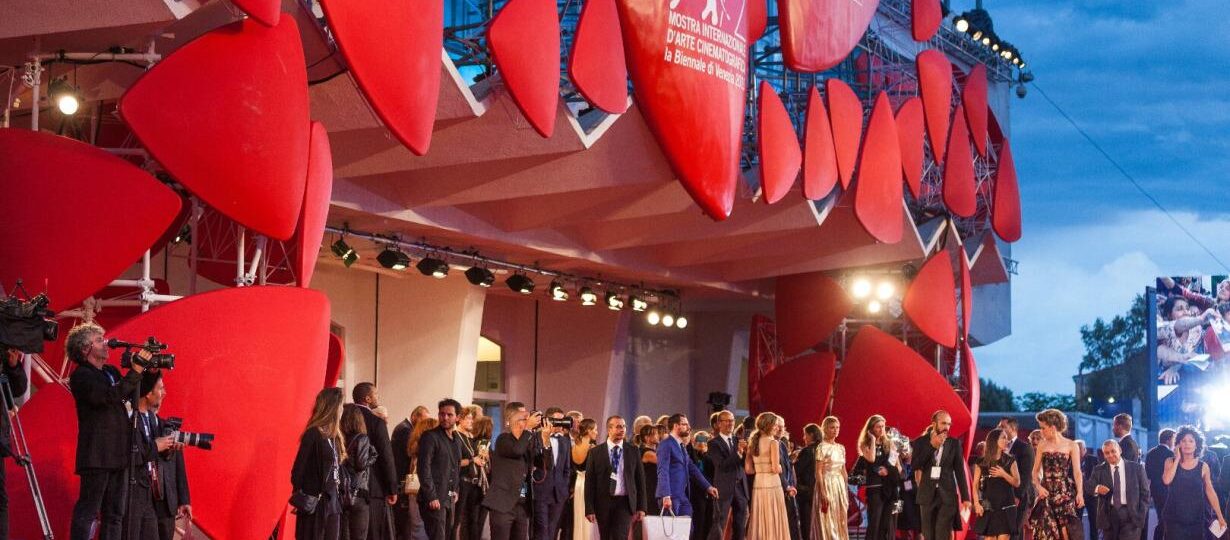
As the Venice International Film Festival prepares to return to the Lido, its 83rd edition promises more than premieres, stars and spectacle. It arrives as a declaration of cinema’s continued power to surprise, provoke and endure.
Every September, Venice appears to perform an act of transformation. Water taxis cut through the lagoon carrying actors, filmmakers and producers; photographers assemble beneath the lights of the Palazzo del Cinema; and the quiet, residential rhythm of the Lido gives way to one of the most influential gatherings in international cinema.
Yet the Venice International Film Festival has never been defined by glamour alone. The red carpet may provide its most instantly recognisable images, but Venice’s real authority is established inside its screening rooms—and in the conversations that begin there before travelling through the wider film world.
From 2 to 12 September 2026, the festival will return for its 83rd edition under the direction of Alberto Barbera. During those eleven days, Venice will once again become both a showcase and a testing ground: a place where established auteurs present their most ambitious work, emerging filmmakers encounter an international audience, and producers begin determining which projects may shape the following awards season and the future of the industry. La Biennale di Venezia
A Festival That Still Makes Films Matter
Venice is the world’s oldest film festival, but longevity alone does not explain its position. Its influence comes from its unusual ability to unite cinema’s competing identities. It treats film as art, entertainment, commerce, cultural memory and political expression—often within the same programme.
The festival can welcome an uncompromising three-hour experiment one evening and a major international production the next without suggesting that one form of cinema invalidates the other. This elasticity is increasingly valuable at a time when the industry is divided between theatrical exhibition and streaming, original storytelling and familiar intellectual property, artistic risk and financial caution.
Venice does not resolve these tensions. It places them in the same room.
That is why a Venice premiere still carries significance. Selection communicates that a film should be discussed, even before any consensus has formed around whether it should be celebrated. The festival offers filmmakers a concentrated moment in which their work is seen collectively, on a large screen, by audiences prepared to respond immediately and passionately.
Applause may continue long after the closing credits. Reactions can also be severe. Both are part of Venice’s character. It is not a neutral launch platform but a living arena in which reputations can be strengthened, expectations overturned and the trajectory of a film transformed in a single evening.
Danny Boyle Opens the Festival
The 2026 edition will open with the world premiere of Danny Boyle’s Ink, starring Jack O’Connell, Guy Pearce and Claire Foy. The film will screen in competition on 2 September in the Sala Grande of the Palazzo del Cinema. Its selection as the opening film immediately gives the festival a distinctive energy: Boyle is a director whose career has repeatedly crossed boundaries between independent urgency and large-scale filmmaking.
From Trainspotting and 28 Days Later to Slumdog Millionaire and Steve Jobs, Boyle’s cinema has often been driven by momentum, visual invention and characters forced to confront systems larger than themselves. An opening-night film carries the difficult responsibility of setting the emotional temperature for everything that follows. With Ink, Venice has chosen not merely prestige but velocity. La Biennale
The competition surrounding it is remarkably varied. Casey Affleck arrives with Company, while Werner Herzog presents Bucking Fastard, featuring Kate Mara, Rooney Mara, Orlando Bloom and Domhnall Gleeson. Hirokazu Kore-eda returns with Look Back, and Lee Chang-dong brings Possible Love, starring Jeon Do-yeon, Sul Kyung-gu, Zo In-sung and Cho Yeo-jeong.
Martin McDonagh’s Wild Horse Nine assembles an extraordinary cast including John Malkovich, Sam Rockwell, Steve Buscemi, Tom Waits and Parker Posey. Nanni Moretti competes with Succederà questa notte, while Lance Oppenheim’s Primetime places Robert Pattinson alongside Merritt Wever, Skyler Gisondo and Phoebe Bridgers. Florian Zeller’s Bunker, starring Penélope Cruz, Javier Bardem, Stephen Graham and Paul Dano, is certain to attract intense attention.
Perhaps the most provocative inclusion is Ilya Khrzhanovsky’s 195-minute Dau, a title likely to challenge the patience, assumptions and moral certainties of its audience. Alongside films from Italy, France, Denmark, Iran, Japan, South Korea and beyond, its presence demonstrates a programme unwilling to settle into a single aesthetic or national perspective.
These are not simply competing titles. Together, they offer an early portrait of cinema in 2026: internationally financed, culturally fluid, star-led in some places and radically austere in others.
A Jury Led by Curiosity
Maggie Gyllenhaal will preside over the Venezia 83 international jury, joined by filmmaker Kaouther Ben Hania, composer and artist Daniel Blumberg, scholar Francesco Casetti, director Xavier Giannoli, Afghan filmmaker Shahrbanoo Sadat and Hong Kong director and producer Johnnie To. La Biennale
It is an intriguing assembly of perspectives. Gyllenhaal understands performance from inside the frame, but she has also developed an assertive directorial identity through The Lost Daughter and The Bride!. Johnnie To brings decades of genre mastery and production experience. Ben Hania and Sadat have created work rooted in political and social realities, while Casetti approaches cinema through its history, theory and changing modes of spectatorship.
The composition suggests that technical accomplishment alone will not determine this year’s Golden Lion. The films most likely to endure will be those that create their own language—works with enough conviction to resist instant categorisation.
Gyllenhaal has described her intended approach not as standing in judgement but as engaging with the selection through curiosity, admiration and excitement. That distinction feels important. At its best, criticism is not the imposition of certainty but an encounter with something that may alter the critic’s own understanding. A festival jury should possess authority, but also the humility to be surprised.
Beyond the Red Carpet
For the public, Venice is often represented through its most glamorous rituals: gowns reflected in the lagoon, arrivals by boat and the concentrated spectacle of the red carpet. For the people building careers in film, however, another festival is taking place simultaneously.
The Venice Production Bridge will run from 3 to 9 September, connecting producers with financiers, distributors, broadcasters, funds and sales agents. Its Gap-Financing Market, taking place from 4 to 6 September, is designed around individual meetings intended to help selected fiction, documentary and immersive projects secure the remaining finance required to move forward. Venice Production Bridge
This is where Venice’s influence becomes tangible. A film festival does not only celebrate completed work; it can help create the conditions in which future work becomes possible.
The Book Adaptation Rights Market will connect publishers and literary agents with screen professionals, while Final Cut in Venice will support six works in progress through three days of presentations and industry encounters from 6 to 8 September. These programmes may receive less public attention than a major premiere, but they are central to the festival’s purpose.
For an emerging producer, the most consequential moment in Venice may not occur beneath the flash of cameras. It may happen during a carefully prepared twenty-minute meeting, in a conversation after a panel, or through an introduction that develops into a co-production many months later.
Venice therefore operates on two timelines. The first is immediate: the premiere, the review, the photograph and the award. The second is largely invisible, unfolding through projects that may not reach audiences for several years.
Cinema Beyond the Conventional Screen
The 2026 Venice Immersive selection will feature 68 projects from 26 countries, further confirming that the festival’s definition of cinema is not restricted to the traditional rectangular screen. Virtual and extended reality, interactive environments and spatial storytelling continue to ask fundamental questions about authorship, spectatorship and emotional presence.
Not every technological experiment will become part of mainstream film culture. That is not the point. Festivals should be places where artists can test forms before the market has decided whether they are commercially convenient.
The danger of discussing immersive media is that technology can become the story, overshadowing the human experience it is meant to serve. Venice’s challenge will be to distinguish novelty from genuine artistic discovery. The strongest projects will not simply demonstrate what new tools can accomplish; they will reveal why a story needed those tools in the first place. Venice Immersive
At the same time, Venice Classics will return with restorations of works by filmmakers including Luis Buñuel, John Cassavetes, Roger Corman, Ann Hui, Ernst Lubitsch, Roberto Rossellini, Ettore Scola and Andrzej Wajda. The coexistence of restoration and experimentation is one of the festival’s most meaningful qualities. Cinema can only move confidently towards its future when it remains in conversation with its past.
Honouring Ellen Burstyn
The Golden Lion for Lifetime Achievement will be presented to Ellen Burstyn, an actress whose career has never depended on surface or easy sentiment. From The Last Picture Show and The Exorcist to her Oscar-winning performance in Alice Doesn’t Live Here Anymore and the devastating intensity of Requiem for a Dream, Burstyn has brought intelligence, danger and emotional precision to roles that might otherwise have been reduced to archetypes.
Honouring her feels particularly appropriate in Venice, where acting is often recognised not merely as celebrity performance but as an essential form of authorship. A great actor does more than interpret dialogue. Through gesture, silence, resistance and vulnerability, they help determine what a film ultimately means.
Burstyn’s award will connect the festival’s celebration of contemporary cinema with a body of work spanning more than six decades. It also offers a reminder that longevity in film is not simply survival. It is the ability to remain artistically present while the industry repeatedly changes around you.
What Venice Must Defend
The 83rd Venice Film Festival arrives at a complicated moment. Audiences have more access to moving images than at any previous point in history, yet individual films must fight harder to command sustained attention. Production costs are rising, independent financing is fragile, theatrical distribution remains uncertain, and algorithms increasingly influence what viewers encounter.
In such a climate, the role of a major festival cannot be merely to decorate the existing industry hierarchy. Venice must continue to defend the possibility of discovery.
That means allowing an unknown filmmaker to occupy the same critical conversation as an established master. It means recognising films from countries whose industries lack the resources to manufacture global visibility. It means giving audiences work that may initially feel difficult, strange or unresolved. And it means accepting that not every important film will generate immediate consensus.
The future of cinema will not be protected by nostalgia. It will be protected by investment in new voices, serious criticism, adventurous production and audiences willing to enter a screening without already knowing how they are expected to respond.
The Light Across the Lagoon
By the time the Golden Lion is presented on 12 September, the festival will have produced its winners, controversies and unexpected discoveries. Giovanni Veronesi’s Dio ride will bring the official programme to a close after the awards ceremony, and the international community will begin departing the Lido almost as quickly as it arrived.
But Venice’s true impact will only become visible later.
Some of its premieres will travel into the awards season. Others will secure distribution in countries far from where they were made. Projects introduced through the Production Bridge will find partners. A debut director may leave with the confidence—and the contacts—to make another film. A performance initially encountered in the Sala Grande may become one of the defining performances of the year.
This is the promise that brings cinema back to Venice: not simply the certainty of prestige, but the possibility of transformation.
For eleven days, the Lido will become a place where the past and future of filmmaking meet—where established names can take new risks, unfamiliar voices can be heard, and cinema can still demand that the world stop, look and listen.
As the lights rise over the Palazzo del Cinema and the first boats approach across the lagoon, Venice 2026 will not merely ask which films deserve to win.
It will ask a far more important question: what can cinema still become?
You may also like...
 Cardi B Performing in Nothing But a Bathrobe Is a Big Mood
 A Midnight Metallic Dress Code Created a Dazzling Scene at The Parrish Museum’s Midsummer Party
 Louis Vuitton Is Opening Its First-Ever Café and Restaurant
 Legendary Shoe Designer Sergio Rossi Dies From COVID-19 Complications
 Jimmy Webb, Trash and Vaudeville’s Beloved Punk, Dies at 62
 The 2020 Met Gala Is Officially Canceled Due to the Coronavirus Pandemic